Friday, September 19, 2025

Marketplace of Ideas: Check on Government Ideas

     In an ideal democracy, the press is more than a guarantee of freedom of press as it is a formidable tool that checks government power. The Checking Function of the First Amendment by Vincent Blasi is an influential work that makes us remember that this is an important role. The press, which is accompanied by a well-informed citizen, is a watchdog, be it that the press is known to be vigilant in uncovering any abuse of power and corruption that would otherwise not be known. History has given us millions of cases: Watergate, Irangate, Clintongate, and others, where investigative journalism uncovered the ills of the government. These exposures did not merely hit the headlines, but it caused widespread anger, legislative inquiries and subsequently political repercussions. This information has allowed citizens to exercise their right to vote out leaders at the ballot box in their exercise of democracy.

Sunlight Foundation, a transparency ...

Symbolic spotlight shining on government buildings represents transparency and scrutiny.W. Mark Felt and Watergate

    Watchdog role of the press is necessary since the power without checks can easily be abused. Government officers, be it executive, legislative, or judicial are human and they can be prone to the temptations of corruption or excess. Injustice can originate in the dark without the light of the press to highlight the abuses.In addition, this check and balance system is not confined to the press only. It also relies on citizens who do not blindly follow the news, but question the information presented in the news and those who take part in democracy. It is mutual freedom of the press and an active people that makes a vibrant defense against tyranny.

    In the current times and times when misinformation and political polarization may pose as a threat to the discourse of the people, the watchdog association of journalism is more valuable than ever. It helps us remember the reason why the right to freedom of the press is not only about the rights of the media, but it also involves the guarantee of the freedom of democracy. The next time you pick up a newspaper and read a headline concerning a political scandal or government malfeasance, do keep in mind: this is democracy at work. The media is performing its role and you, as an educated citizen, have the authority to seek responsibility.

Supreme Court Reflection

Supreme Court of the United States ...
Logo of the Supreme Court

     The Supreme Court of the United States is the most powerful Judicial authority in the Nation. Its influences do not come from  force or military but from the trust of the American people and as I saw in the video, having the goal to make decisions of what is best for the country. The Court serves as the final interpreter of the Constitution, ensuring that justice is applied fairly and that the balance of power among the three branches of Government is sustained.

    More then 200 years ago, John Marshall a lawyer from Virginia was appointed chief justice. His leadership resulted into the court becoming a coequal branch of government with real authority. In one of the most important moments in the Court's history, Marshall and his colleagues struck down a law passed by Congress, declaring it unconstitutional. This decision established the principal of judicial review, which allows the Supreme Court to design whether laws align with the Constitution. Marshall helped shape the relationship between Congress, the President and the Judiciary ensuring that no branch could dominate the government.

Justia U.S. Supreme Court Center    However, not all of the Court's decisions have strengthened its reputation. One of the most infamous rulings in U.S History was the 1857 Dred Scott decision. This ruling stated how if you are African American, no matter any circumstances, you could not be a citizen of the United States. This went down as one of the worst decisions the Supreme Court has made, weakening Congress's authority, dividing the nation, and pushed the United States closer to the Civil War. This highlighted that the courts rulings could either unify or destabilize the country depending on how justice was interpreted.

    The Civil war and the reconstruction amendments to the Constitution ultimately overturned the Dred Scott decision. The thirteenth amendment abolished slavery, the fourteenth amendment granted citizenship to all people born in the United States, and the fifteenth amendment secured voting rights for African American men. In today's world, the Supreme court continues to play a crucial role in the United States Government. Each Justice meets regularly to discuss issues, debate their views, and vote on outcomes. In conclusion, the Supreme Court has played a defining role in shaping the united states. 

What Does The Bible Say About Slavery

In the theme of religion, the Bible shows a development of the relationship between outer practices and laws and the inner one, the inner change, and true devotion. The Old Testament focuses on the sanctity of the covenant, on worship, and on the observance of laws as the principal support of the religious life. It is also shown that justice and compassion should follow the religious practice, or it would be useless. This theme is also reflected in the New Testament, which portrays religion based on belief and uprightness, as well as reflecting compassion for the needy people. True devotion has to do with less ritual and more about how well someone loves and serves.

The Old Testament offers a social and economic institution that had to regulate slavery. The texts impose restrictions on the term of service of a few individuals, particularly among fellow Israelites, and more enduring types of service on foreigners. The writings also came up with safeguards that were very uncharacteristic of their time, like instructions that the runaway slaves should not be compelled to be returned to their masters, but let them live a life as they wish. This control/protection shows not only a cultural acceptance of slavery, but an attempt at confining its worst impact.

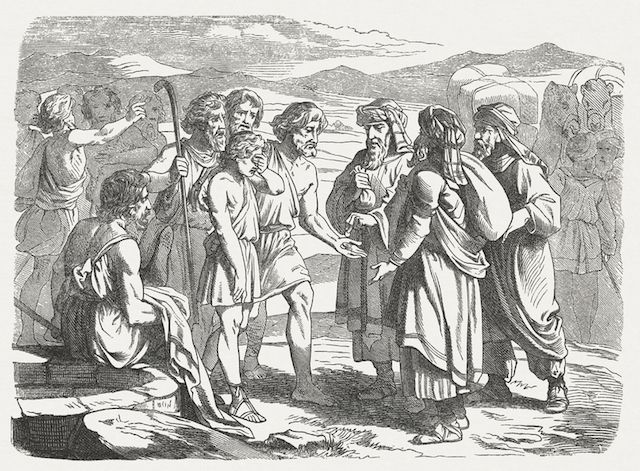
Genesis 37 - Joseph sold into slavery - Scene 05 - Goat's blood | Bible  Cartoons
Genesis 37, Joseph being sold into slavery

The Bible deals with the topics of slavery and religion as its reflected societies served as the foundations of connection on this matter. This content has given a combination of cultural acceptance, regulatory teaching, moral guidance, and values, which would go on and pose challenges to the principles of systems that were initially assumed to be right. Although there are also parts that seem to justify slavery, the rest act to demolish that and try to actually justify it. The parts show that there is a clash that exists between the truths of the old world and modern justice and compassion as they develop across the biblical chapters.


The Bible and Slavery 
Does the Bible Condone Slavery? | Emergence Church - New Jersey
An Illustration Showing Slavery in Ancient Times


The New Testament is representative of the Roman Empire, where slavery was a common practice. The writers did not demand a specific ending of the institution, but rather provided moral prescriptions that weakened the association between masters and the slaves. Slaves were expected to fulfill their duties diligently, and their masters were encouraged to be tough and not cruel. In the same direction as these directions, however, there are indications of a loftier vision. Freedom is implied to be better when available, and the relationship between believers is redefined as family relationships, regardless of social status.


In the comparative analysis of how slavery is treated in the Bible, one may notice its acceptance and criticism. Its regulations, which presuppose slavery as one of its normal lives, find their acceptance. The criticism has grown in its limitations, its safeguards of the weak, and its larger conception of human equality before God. These aspects eventually inspired the later generations to counter by saying that slavery was not consistent with the other underlying principles of freedom and dignity within the tradition.We have been showing how the manifestation of a conflict between the reality of culture and the ideal of morality is witnessed in the Bible. It accepts slavery as a reality of early life, but puts elements that jeopardize its permanence. Simultaneously, religion is never constituted by ritual only but rather by implicit and sheer devotion, manifested by justice, compassion, and love.


https://www.catholic.com/magazine/print-edition/slavery-and-the-new-testament?

https://davidwilber.com/articles/making-sense-of-biblical-slavery?

https://www.theologyofwork.org/old-testament/exodus-and-work/israel-at-mount-sinai-exodus-191-4038/instructions-about-work-exodus-201-17-and-211-239/case-laws-in-the-book-of-the-covenant-exodus-211-2333/slavery-or-indentured-servitude-exodus-211-11